The Class-List Cartel: Surviving Christmas Card Season Without a Glitter-Related Breakdown
Photo: Stephen Armstrong , CC BY-SA 2.0, via Wikimedia Commons
Every November, a piece of paper arrives home in a book bag looking innocent enough. It has thirty names on it, possibly two Archies, three Islas and a child known only as 'Poppy H. (not Poppy B.)'. Congratulations: you have been drafted into the primary school Christmas card exchange. There is no training, no budget and no official stationery allowance. Just you, a pack of cards and a vague memory of last year's late-night sellotape incident.
This is not about creating a Pinterest-worthy card-writing corner with twine and a homemade hot chocolate station. This is about getting thirty small rectangles signed, labelled and out the door before the last day of term, without anyone crying into a tub of sequins. Usually you.
The list arrives like a bill you didn't order
The class list is a strange document. It lands with no warning and immediately creates admin. You are expected to cross-reference names, match them to faces at the school gate, and work out whether 'Charlie' is Charlie in Reception or Charlie the taller one who once headbutted a coat peg.
Take a breath. You do not need to become the Post Office. You need a plan that fits around work, tea, PE kits and the fact that someone has definitely lost a shoe again. The goal is not perfection. The goal is thirty cards that look broadly festive and do not require a second mortgage.
First job: decode the names without losing the will
Sit down with the list and your child for five minutes. Not thirty. Five. Ask them to tell you who is in their friendship group, who sits near them, and who they actually want to give a card to. You may discover that the full list is optional, or that your child has strong opinions about a child you have never heard of.
If the school expects the whole class, fine. If your child wants to include a few extras, also fine. But do not spend an evening trying to work out whether 'Evie-Mai' has a hyphen or a space. Write the name as it appears on the list, accept that someone will be misspelled, and move on. This is a card exchange, not a legal document.
Buy cards like a grown-up, not a craft influencer
The most useful Christmas card advice I can give you is this: bulk-buy. A box of thirty or forty cards from a supermarket, Card Factory or the school fair tombola is your friend. They do not need to be personalised. They do not need to feature your child's face. They definitely do not need to be handmade.
Avoid glitter. This is not a moral judgement; it is a practical one. Glitter gets everywhere. It gets into the carpet, the car, the butter, and the baby's nappy. You will still be finding it in March. If a relative gives you glitter cards, thank them politely and hide them in the back of the cupboard for a different decade.
The sticker system that saves your sanity
Here is the system that has worked in our house. Get a sheet of small sticky labels, the plain ones you use for jam jars and school jumpers. Write each child's name on a label once. Then stick the labels onto the cards. Your child can sign the inside, or draw a festive potato, or simply write their own name. The label does the heavy lifting.
If you are feeling organised, sort the cards into two piles: the definite friends and the rest of the class. Label the definite ones first. Then work through the rest in alphabetical order. It is boring, but boredom is underrated. Boring gets finished. Creative gets abandoned at 10pm while you are googling whether you can post a card to a child in Year 2 via the school office.
Set up the card-writing station (one evening, not one fortnight)
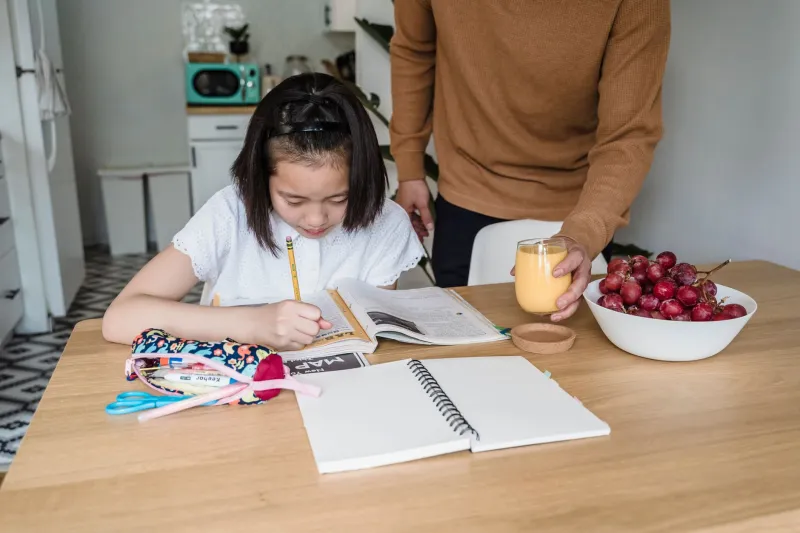
Pick one evening. Not a school night if you can avoid it. Clear the kitchen table, put down a wipeable cloth, and set out three things: cards, labels and a pen. That is it. No glue, no glitter, no festive washi tape. If your child wants to add a drawing, they can use the pen. If they want to add a sticker, they can use the labels. Keep the bar low and the finish line visible.
Put on something you all like, make a cup of tea, and give it forty-five minutes. If you have younger children, they may sign five cards and then wander off to build a den out of cushions. That is allowed. You can finish the rest while they are asleep, or you can accept that some cards will be signed with a single wonky 'M' and a thumbprint. The recipient will not call Ofsted.
The cut-off time is sacred
Decide now when card-writing stops. It might be 7:30pm. It might be when the tea goes cold. It might be when you have written the same name three times and started questioning your life choices. Whatever it is, stick to it.
The cut-off stops the task from expanding to fill the entire week. It also stops you from turning a small festive gesture into a personality test. If a few cards do not get written, the world will not end. The class list is not a legal contract. The school will not send a bailiff. The other parents are probably also sitting at their kitchen tables wondering why they bought cards with individual envelopes that need peeling apart.
What about teachers, siblings and the child who gives everyone a candy cane?
Be realistic. Teachers do not need a card from every family, but a shared card from your child is a nice touch if you remember. Siblings can be included if you have spare cards. The child who gives everyone a candy cane is a lovely human being, but you do not need to match their energy. This is not a festive arms race. It is a card exchange.
If your child comes home with a card from someone not on their list, add them to the pile if you have a spare. If you do not, let it go. Nobody is keeping a spreadsheet. And if they are, that is their hobby, not yours.
Let the child sign badly and move on
There is a temptation to take over. To write the names neatly, to correct the spelling, to make the cards look like they were produced by a small stationery brand. Resist it. The point of the card exchange is that your child participates, not that you produce a perfect batch of festive correspondence.
A badly spelled name, a wobbly snowman and a card that has been licked shut with too much enthusiasm are all fine. They are actually better than fine. They are evidence of a child doing something themselves. You have enough jobs. Let this be one they can mostly do.
The morning after
When the cards are done, put the leftover labels and cards in a cupboard and close the door. Do not leave them on the kitchen side to taunt you. Do not start wondering if you should have included the teaching assistants. You have completed the class Christmas card exchange. You have survived the list, the identical names and the glitter-free zone.
Next year, you will do it again. But next year, you will know the secret: thirty cards, one sticky label, and a firm cut-off time. And maybe a mince pie. You have earned it.