One Night Only: Surviving the Great School Christmas Concert Ticket Bunfight
The email lands at 7.14pm on a Tuesday. The subject line reads IMPORTANT — Christmas Performance Tickets, in the sort of bold red that suggests a bank has noticed suspicious activity on your account. By 7.16pm the class chat has forty-seven messages and someone has already typed the words 'just to clarify'. By 7.20pm you have read the letter four times and you still aren't sure whether your child is in the Tuesday afternoon show or the Wednesday evening one, or whether your mother technically counts as a 'family member' under the two-per-family rule.
Welcome to ticket season. It is the most competitive fixture in the primary school calendar, and the prize is a plastic chair with a view of your own offspring for roughly four minutes.
First, decode the letter
School communications are written by people who are extremely good at their jobs and extremely frightened of the phrase 'but you didn't say'. The result is a document with nine bullet points, a table, two sentences in capitals, and at least one line doing an enormous amount of quiet legal work — usually something like: 'due to hall capacity, each family may request a maximum of two tickets across all performances.'
Note the word request. It is not decoration.
So, in the first hour: read it twice, screenshot the table, and put both the performance time and the doors-open time in your calendar. Those two times are thirty minutes apart and that gap will decide your entire evening. Then return the slip. Not because returning it first gets you anything extra — it doesn't — but because it makes you feel like a person with a system, and in December that is worth a lot.
The two-ticket rule is a budget, not a gift
Two tickets comfortably covers two parents. Two tickets does not cover two parents, one grandmother, one grandfather who has driven ninety minutes, and a nine-year-old sibling who 'wants to see it too', by which they mean they want to sit in a warm room with a snack and be praised for being supportive.
So treat the allocation as a budget rather than a birthright. Decide who actually needs to be in the room, and then be ruthless about the rest. Anyone who is not in the room gets the video. Everyone in our family has watched a shaky clip of a Reception class singing a song about a donkey, and honestly, they've all survived it.
Deploy the grandparents like a specialist unit
Grandparents are the special forces of concert season: highly motivated, free on a weekday afternoon, and liable to arrive with a camcorder and a running commentary.
The trick is to station them at a different performance from the one you attend. Plenty of schools run an afternoon show and an evening show for precisely this reason, and spreading the family across both is the closest thing to a cheat code you'll get. Everyone gets a wave, nobody sits through the recorder ensemble twice, and your mother-in-law gets a story she can retell until Easter.
If there is only one performance, take turns and take it gracefully. The arrangement that has worked for us: parents at the evening show, extended family at any daytime showing the school allows. If there is genuinely only one slot, draw straws. Real straws. In front of witnesses. It avoids the annual argument about whose turn it was, which nobody ever remembers accurately anyway.
When Year 2 and Year 5 clash
This is the classic December ambush: two children, two year groups, two performances on the same evening, one set of legs.
Divide and conquer is the only sane answer. One adult per child, phones fully charged, agreed meeting point at the end, and a firm rule that neither parent is allowed to text the other with 'have you seen this bit?' while the other is trying to film a shepherd. If both shows happen to run back to back, you can sometimes catch the second half of one — but do not build your evening on it. Build it on the plan, then enjoy the bonus.
The unwritten code of the school hall
There is no published filming policy, but there is absolutely a code, and everyone knows it:
- Film in landscape or don't film at all. Nobody needs a vertical video of your own thumb.
- Two minutes maximum. The full twenty-minute show filmed from row four is a file nobody will ever open twice.
- No flash, ever. You will blind a small shepherd and be remembered for it.
- Never upload footage containing other people's children without asking. Nope, not even the funny bit.
- Clap for every child. Every single one. It costs nothing and it is the whole point.
- Stay out of the aisle. The aisle is not a vantage point, it is a trip hazard with ambition.
Nobody is actually waving at you
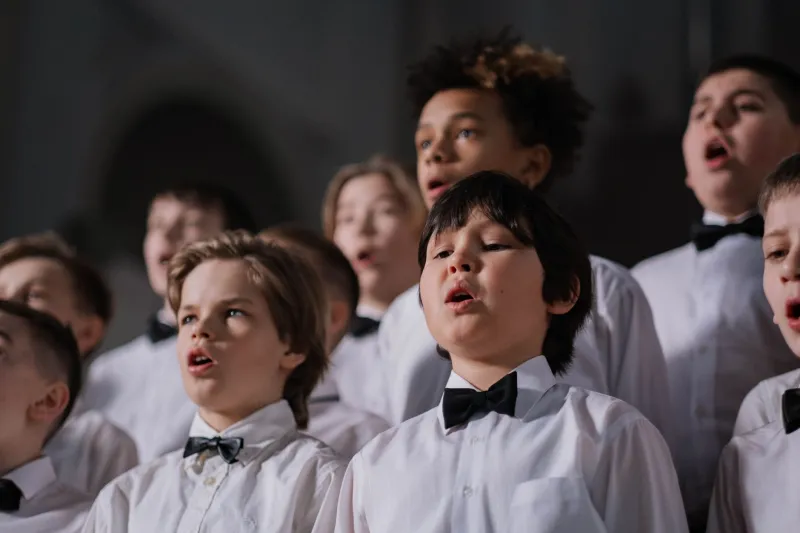
Here is the truth about the rehearsed wave: your child has spent three weeks being taught to sing two songs and wave at a designated corner of the hall, which, on the night, will be occupied by a stranger in a very nice scarf.
They will spot you eventually — usually halfway through verse two — and will look briefly alarmed, then delighted, then slightly sick, and then they'll carry on. That wobble is the whole performance. You will not remember the songs. You will remember the face.
So don't promise a wave. It raises the stakes for everyone. Say 'I'll be the one clapping loudest' and leave it there.
Small logistics, large consequences
Arrive twenty minutes early, because the car park holds roughly eleven cars and the verges are already taken by someone who arrived at ten past six. Bring cash — the raffle has never once accepted a card. Folded coats make acceptable cushions on those chairs. And know your exit route before the final number, because the second the lights go up, four hundred people will attempt to leave through one set of double doors.
And then it's over
Fifty-five minutes in a plastic chair, one slightly wobbly rendition of a carol you've heard since September, and about four seconds of eye contact. That's the deal. It is, somehow, entirely worth it.
Just return the slip tonight. And if you could avoid being the person who types 'just to clarify' into the class chat, the rest of us will be extremely grateful.